
NEWSLETTER SEPTEMBER 2026
COFA / ARC WHAT CHANGE FROM 1st OCTOBER 2026
From 1st October 2026, the airworthiness management requirements for French aircraft operating under a CNRA, CDNR, CNRAC or CNSK will change. This therefore directly concerns many MCR owners whose aircraft are operated under a CNSK.
At the first renewal due after that date, the current Certificate of Airworthiness (CDN), which carries an expiry date, will be replaced by a new permanent CDN with no expiry date. The aircraft’s continuing airworthiness will then be evidenced by a separate document: the Airworthiness Review Certificate (CEN).

The CEN will be issued following a satisfactory airworthiness review and will be valid for one year. Subject to certain conditions, it may then be extended twice, each time for a further one-year period, before a new full airworthiness review is required.
Do you need to take any action now?
No. Current CDNs will remain valid until their existing expiry date. The transition to the new system will take place at the first renewal carried out after 1 October.
For owners whose aircraft are followed by RSANav and whose membership fees are up to date, RSANav states that the transition will be handled during the renewal visit: the PEN — airworthiness review personnel — will provide the new CDN and collect the previous document for return to OSAC.
For all other owners, we recommend contacting the organisation or PEN responsible for the airworthiness follow-up of your aircraft.

An important point: all findings must be rectified
The main change concerns any findings raised during the airworthiness review. A CEN cannot be issued until all findings have been closed, including Level 2 findings.
These may involve discrepancies that do not immediately compromise flight safety, such as missing placarding, an overdue inspection or a minor defect on the aircraft.
For this reason, it may be advisable to bring the review forward. It can be carried out up to 90 days before the expiry date without changing the date of the subsequent cycle. This three-month window gives owners time to rectify any findings before the current document expires.
A Level 1 finding, which seriously compromises flight safety, must of course be rectified before any further flight.
Two possible extensions
Subject to certain conditions relating to the aircraft’s continuing airworthiness and maintenance, the owner may extend the CEN twice, each time for a further one-year period, with the extension carried out up to 30 days in advance.
After each extension, a copy of the CEN must be sent to the competent authority within the prescribed time limit. For RSANav members, a copy must also be sent to RSANav.
Please note: an aircraft with an expired CEN may not be flown, unless a specific authorisation has been granted by the competent authority. An airworthiness non-compliance may also have insurance implications, so owners are advised to check the terms of their policy.
ROTAX : TECHNICAL BULLETINS TO WATCH CLOSELY!
Several airworthiness directives and technical bulletins concerning Rotax engines have been issued in recent months. They may have raised some concerns, but it is important to stress that they do not constitute a general alert affecting the entire Rotax range.
Each publication applies only to specific engine models, part numbers and/or serial numbers.
912 ULS gearboxes: check your serial number anyway!
EASA published AD 2026-0170 on 1 September, which became effective on 8 September, concerning certain gearboxes fitted to Rotax 912 ULS2 engines.
The directive directly applies to four certified aircraft types — the Evektor SportStar RTC, Viper SD-4 RTC, Breezer B600 and PS-28 Cruiser — and therefore does not directly apply to MCR aircraft.
However, that is not the end of the story.
The Rotax ASB-2026-001 / ASB_A-2026-001 that prompted this measure also applies to certain non-certified 912 UL, 912 ULS, 912 iS Sport and 914 UL engines, depending on the engine or gearbox serial number. These engine types are widely used in light aircraft, including some MCRs.
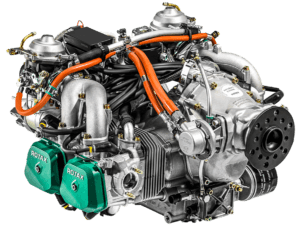
The identified issue concerns the possible absence, during assembly, of an oil jet and/or the M7x16 screws securing the propeller shaft bearing. Under certain circumstances, this defect may lead to an oil leak or even an in-flight engine shutdown.
If your MCR is fitted with a 912, 912 iS or 914 engine, it is therefore advisable to check both the engine serial number and the gearbox serial number against the latest revision of the relevant Rotax bulletin.
And about our new MCR-4S with the Rotax 916 iS…
A second publication also deserves close attention.
In early September, Rotax issued Alert Service Bulletin ASB-2026-002 / ASB_A-2026-002, covering certain 915 i and 916 i engine series and requiring replacement of the turbocharger valve housing.
The issue stems from a manufacturing defect that may cause the housing to crack. This could result in an oil leak reaching hot parts of the exhaust system, potentially causing smoke or, in the worst case, a fire.

EASA has since issued Emergency AD 2026-0178-E, which became effective on 16 September and applies to the certified 915 iSc and 916 iSc versions.
The MCR-4S Evolution is equipped with the Rotax 916 iS, not the certified 916 iSc version directly covered by the EASA AD. However, this does not mean the issue can be ignored: the Rotax bulletin also covers non-certified engine series, and its applicability must therefore be checked against the relevant configuration and serial numbers.
The right approach: check, don’t panic
In recent years, Rotax has issued several targeted measures concerning components such as propeller shafts, gearboxes, lubrication systems, electrical systems and turbochargers.
This series of bulletins does not mean that all engines are affected. A Rotax engine is not concerned simply because it belongs to a particular family: the exact engine model, serial number and, where applicable, the serial number of the affected component must always be checked.
If you are in any doubt about your MCR, please contact SE Aviation Aircraft before carrying out any work.
Regulations, maintenance requirements and manufacturer bulletins are all part of an aircraft’s operating life and serve as a reminder of how important it is to keep all documentation fully up to date.
The SE Aviation Aircraft team remains at your disposal to provide support and help determine whether your aircraft or engine is affected by any of these measures.
Safe flying to all.